By Bandana Rana
Sep 8, 2026 – A week after my first visit to Nuwakot, I returned to see what had changed.
There were some encouraging signs. The number of holding centres has increased from 17 to around 25. During my previous visit, I had raised concern about the absence of women security personnel in the centres. This time, I was relieved to see female security personnel present.
Civil society organisations have also stepped in. Near some holding centres, safe spaces for women and children have been established. There are tents providing counselling, and in some places, open spaces with toys and play areas for children.
These are important steps. But they are still far from adequate for the scale and complexity of the crisis.
What struck me most during this second visit was not only the physical devastation, but the stories of those who have survived—and the enormous uncertainty about what comes next.
I met a grandmother who had lost almost her entire family. All that remained was her 16-month-old grandson. His mother and two siblings had been swept away.The child cried continuously, desperately seeking his mother’s breast. In her grief, the grandmother carried an unbearable sense of guilt. Perhaps, she thought, the mother had gone back looking for the child she had been carrying when she fled.
“I wish I had died and she had survived,” she said. “At least this child would have had his mother.” There are no easy words in the face of such grief.
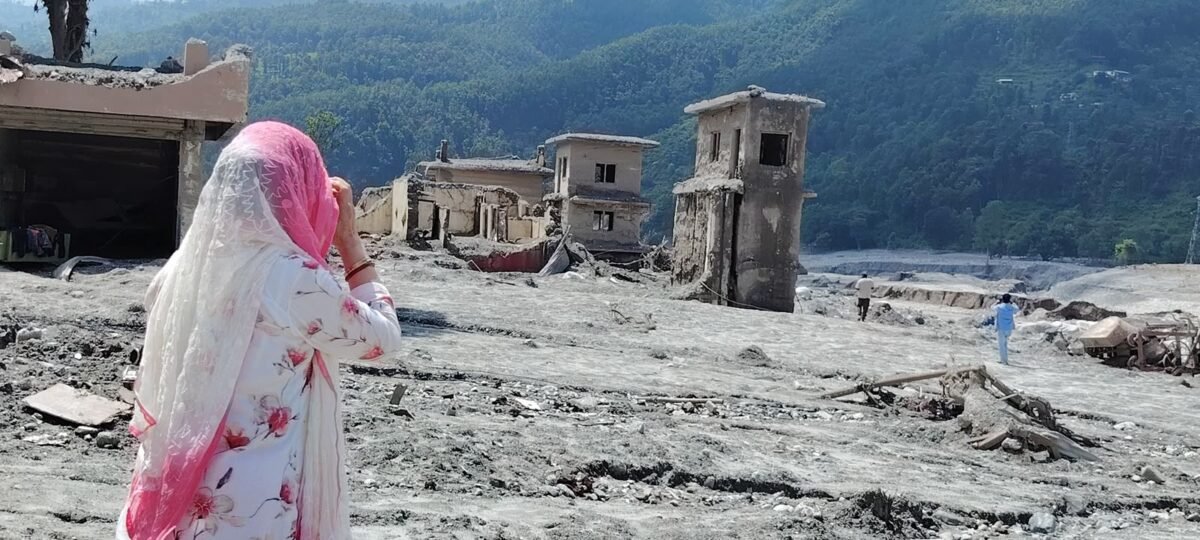
I met another survivor, a schoolteacher, with her young daughter. Her four-storey home stood partly buried—two floors swallowed by the disaster. Her courtyard, cow farm and almost everything she owned had been washed away.
It is understood that many families in the affected districts kept their savings, jewellery and cash at home. For them, the loss is not simply of a house. It is the loss of years of savings, security and livelihood. She was in tears looking at what remained of her home. Yet her source of comfort was simple: “At least my family members are safe.” Her hope now rests on her young children. Perhaps, she said, they will one day rebuild what has been lost.
But that hope comes with a heavy burden.
Many young people who were planning to continue their education may now have to abandon those dreams and begin earning to support their families. For a young person, rebuilding a home, restoring a livelihood and caring for a traumatised family can be an enormous responsibility.
Then I met a man with two very young children who had lost his wife.
“How will I bring them up without their mother?” he asked. He has lost his property and must now find work to earn an income. But while he works, who will care for his children?
There are many such stories.
People who have lost mothers, fathers, husbands, wives, children and siblings. Families who have lost homes, livestock, land, savings and livelihoods. Children who have lost parents. Older people who have lost the communities in which they spent their entire lives.
It leaves one bewildered: how will all these losses be addressed?
This is the immense challenge before the government and local authorities.
From holding centres to where?
I spoke with the Deputy Mayor, who informed us that the holding centres are expected to close within a week and that those staying there will be relocated. On one hand, it is encouraging to see the authorities moving quickly. People cannot remain indefinitely in temporary holding centres. But after seeing the people living there and understanding the nature of their losses, I cannot help asking: where are they being relocated to, and are they truly ready to return?
For many, there may simply be no home to return to. Entire communities have been swept away. Some have lost their livelihoods. Some have lost the family members who would have helped them rebuild. Others are caring for young children or elderly relatives while themselves struggling with profound trauma.
There are also reports that children who have lost their parents may be sent to children’s homes, while older people may be sent to old people’s homes in Kathmandu. Perhaps these options are necessary in some cases. But relocation cannot simply mean moving people from one place to another.
It must mean rebuilding lives.
And relocation has a significant gender dimension that cannot be overlooked.Women and girls may face increased risks of sexual and gender-based violence, exploitation and harassment in unfamiliar or overcrowded environments. Women may lose access to livelihoods, healthcare, reproductive health services and community support networks. Those caring for children, older people or persons with disabilities may face an even greater burden.
Widows, single women, adolescent girls and women-headed households may be particularly vulnerable. For children, especially girls, separation from familiar families and communities can create additional protection risks. Relocation must therefore be safe, dignified, gender-responsive and participatory. People must have a voice in decisions affecting where and how they will live.
Trauma does not end when the water recedes
Another worrying issue is the amount of misinformation circulating online and through social media. For someone who has just experienced unimaginable loss, fear and displacement, it can be extremely difficult to distinguish what is true from what is false. A traumatised mind is already struggling to make sense of reality. Misinformation can deepen fear, confusion and distress.
Clear, timely and trusted information is therefore not a luxury. It is part of humanitarian protection.
People need to know where they will go, what support they are entitled to, what services are available and what decisions are being made about their future. Information must reach women, children, older people and those who may be excluded from digital platforms.
The emergency is not over
A week later, I saw progress. More holding centres. Women security personnel. Safe spaces. Counselling tents. Spaces for children.
These are positive developments, and they matter. But they must be matched by an equally strong commitment to what comes next.
The floodwaters may have receded, but for thousands of people the crisis continues—in the form of grief, trauma, displacement, lost livelihoods, destroyed homes and an uncertain future.
I appeal to the Government, local authorities, humanitarian agencies and civil society: please do not measure the end of this crisis by the closure of holding centres.
– Listen to the people who have survived.
– Understand their individual circumstances.
– Keep families together wherever possible.
– Protect women and children from further harm.
– Ensure that relocation is safe, dignified, gender-responsive and based on consultation.
– Provide sustained psychosocial support, education and livelihood assistance—not just immediate relief.
And above all, remember that every statistic represents a human being trying to rebuild a life after losing almost everything.
The flood may have passed. Their pain has not. Our responsibility must not end here.
Flood Response: Click the link below to download